
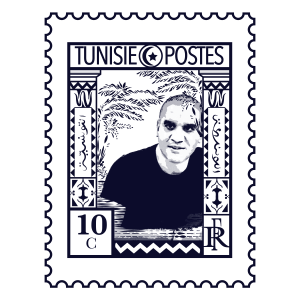
Tunisian journalist Walid Bourouis now lives in exile in France. His crime? Criticising the authoritarian regime of President Kaïs Saïed. Bourouis condemns decree-law 54, which restricts press freedom and silences all opposition. His story highlights the increasing repression of media and activists in Tunisia.
By Nesreen Yousfi (edited by Rogerio Simoes)
Tunisian journalist and rights activist Walid Bourouis (39) has been fighting for free speech in his home country for over a decade. His activism has made him the target of threats and harassment by Tunisian authorities since 2016.
However, he crossed the line on the 16th of February 2023, by denouncing the Decree Law 54, a code introduced by President Kais Saied in 2022 which Walid Bourouis argues serves one purpose: “to silence all potential opposition”. Bourouis now lives as a journalist in exile in France, remaining steadfast in his fight for press freedom.
“The situation in Tunisia right now is worse than dictatorship,” Walid Bourouis said, in an interview with aidóni. “[Under the previous regime of Ben Ali] the media sphere was at least slightly liberated. Since the 25th of July 2021, it’s been a nightmare”.
The date he refers to is the day when President Kais Saied dismissed the government of then Prime Minister Hichem Mechichi and imposed an autocratic regime, in what became known as a Tunisian self-coup. Since then, press freedom in the country has been in steep decline.
A decree threatening journalists
The 39-year-old journalist began his career as a journalist in 2009, Walid Bourouis has worked as a producer and editor-in-chief for a number of media production companies, including Cactus Prod., in Tunisia. He was elected as president of the union branch of the National Union of Tunisian Journalists (SNJT) in 2016, a role through which he defended his colleagues from wrongful dismissals and promoted the rights of journalists to work freely.
The situation in Tunisia became more danguerous for Bourouis after he publicly condemned Decree Law 54, issued in September 2022. The decree legislates that intentionally spreading rumours or false news can be punishable by a fine of 50,000 Tunisian dinars (15,670 Euros), and from five to ten years in prison – with the longest prison sentence applied if any information ruled to be false targeted a public official.
Threatened with harsh penalties for daring to speak out against the decree and the increasingly oppressive regime, Bourouis felt he had no choice but to flee his homeland, on the 25th of April 2023, seeking asylum in Toulouse, France. He turned to a number of fellow journalists to support him in his departure: “I was welcomed by the SNJ-CGT and other union organisations. It was a very smooth process thanks to my colleagues.”
The country Walid Bourouis left behind was once the hope for democracy in the Arab world. After launching the Jasmine Revolution in 2011 by overthrowing the dictator Zine El-Abidine Ben Ali, the North African country escaped civil war and adopted a multiparty system – a path also taken temporarily by Egypt during the Arab Spring. It was in the wake of this revolution that Bourouis began to fight for freedom of speech in his country. “Tunisia was an example that inspired several other countries in the region”, he told aidóni. It entered a democratic transition which, albeit fragile, was “a real democracy for ten years”.
That was until the unilateral takeover by the current President Kais Saied in 2021 (inaugurated in October 2019), a man who Bourouis describes as a leader who is at once a “dictator, fascist, and populist”. In July 2021, Kais Saied started ruling by decree, dissolving the government and freezing parliament. At the moment, Bourouis said, “there is only one political colour – it’s the colour of Kais Saied”.
President Saied signed the Decree Law 54 the following year. Its impact on Tunisian democracy has been both extensive and dramatic. According to the organisation Reporters Without Borders’ press freedom ranking, Tunisia dropped from 72nd in the world in 2019 to 121st in 2023. Bourouis believes Tunisia’s ranking will decrease again”.
According to media professionals, the situation on the ground has been a real nightmare for them. Since the decree was issued, there has been a surge in arrests of journalists and other media professionals. The International Federation of Journalists (IFJ) revealed that more than thirty journalists were arrested in 2023 alone. Reporters Without Borders notes that the decree is particularly harmful as it fails to specify what counts as rumours and/or fake news, inviting subjective interpretation by authorities and prosecutors. “The Decree Law 54 targets what’s happening on social media and traditional media… nobody can escape it”.
A “clear message” to journalists
Walid Bourouis draws attention to the case of Noureddine Boutar, the director of Tunisia’s top radio station, Mosaïque FM. A strong critic of Saied’s authoritarian rule, Boutar was arbitrarily detained on the 13th of February 2023 and released on a bail of 1 million Tunisian Dinars (about 300,000 Euros) on the 24th of May 2023. “The message was clear for everyone”, says Walid. “You either cooperate or you end up in prison. After the release of Noureddine Boutar, everyone knows that going after Kais Saied would mean automatically going to prison.” Freedom House reports that several media professionals have been practising self-censorship since the decree.
“There is a fearful atmosphere reigning amongst journalists”, says Walid Bourouis, repeating this phrase several times throughout the conversation with aidóni – a fearful atmosphere. “I know that other journalists who are in Tunisia are practising self-censorship. And if not them, their editors,” he says. “It’s a country which has turned into an open-air prison for political opponents, journalists, and rights activists (…) The common factor is defying Kais Saied”. Nonetheless, when asked if he had – or would ever have – restricted his own freedom of speech, Bourouis says that “self-censorship has no place in my dictionary”.
As long as Walid Bourouis stays off Tunisian soil, he believes he is safe from any kind of action from the part of his country’s government. He has not abandoned, though, his fight for press freedom back home. “We’re continuing to move things along here in France. Of course, we don’t have a lot of influence”.
“The journalists who are working on the reality of what’s happening in Tunisia cannot put their feet in Tunisia. As long as Kais Saied is in power, it’s impossible for me [to return]. Going back to Tunisia would mean going directly to prison.”
Despite circumstances looking bleak, he believes the current regime will collapse eventually. “Democracy doesn’t come in ten years… Revolution is a whole process… This regime will fall, with this economic crisis, with freedom and democracy in crisis, Kais Saied will fall.”
He also believes he will be back in his country. “I know full well that one day I will return to Tunisia, I will continue this fight”.
This article is part of the special series “Tunisia – Land of Passage”, produced by Specto Media and aidóni. Listen to the podcast here.

 aidoni.org
2 thoughts on ““You either cooperate or you end up in prison,” says Tunisian journalist in exile”