
This article, produced by Brazilian organisation O Mundo Que Queremos (The World We Want), shows how a group of small producers in the northern Amazon Basin recovers degraded land through measures such as soil correction and land rest.
Amanda Lemos, from Oriximiná (Pará State, Brazil)
The municipality of Oriximiná, in the Lower Amazon region – along the Trombetas River, which flows 700 kilometers to join the Amazon River – is home to ranchers attempting to adopt sustainable cattle farming to balance animal husbandry and environmental preservation. This could help reduce deforestation of the Amazon rainforest. The success of these ranchers in improving their practices is a decisive indicator for the Amazon, and in a way, for the world.
The Amazon rainforest stores carbon equivalent to 30 to 40 years of emissions from the United States of America. This vast carbon reservoir is crucial for global climate regulation. Keeping the forest intact would prevent the massive release of carbon, essential for mitigating global warming and preserving biodiversity.
The future of the forest is linked to livestock activity. More than 40% of Brazil’s cattle herd is already in the Amazon, its expansion has been taking place in that region, and over 90% of the Amazon deforestation is within the livestock supply chain. Stopping the deforestation cycle to open new areas for cattle ranching is the most important challenge for saving the forest.
Brazilian agriculture alone emits a quantity of greenhouse gases comparable to entire countries like Japan. Improving how cattle is farmed is a fundamental challenge for the survival of the Amazon Rainforest, as sustainable practices can significantly reduce environmental impact, conserve biodiversity, and contribute to mitigating climate change.
The myth of job creation
Strongly affected by the “occupy to avoid surrender” motto of the military dictatorship in the 1970s, cattle ranching in Oriximiná is an old practice, says 44-year-old rancher and veterinarian Luiz Junior. He began adopting the practice of land recovery in 2018 with 1.7 hectares and now has 57 hectares, an increase of over 3,000% in six years. He was part of a group of approximately 80 rural producers who joined the Pecuária Sustentável (Sustainable Livestock) project. In addition to using intensive livestock concepts, their relationship with workers and animals is also rethought to ensure better performance and revenue.
With a favorable climate, rain, and good grass year-round, cattle ranching is common in the city, even though is not the main occupation according to the Relação Anual de Informações Sociais (Annual Social Information Report), a federal report. The economic sectors that employed the most workers in 2022 were public administration, defense and social security, extraction of metallic minerals, and building construction.
This is a common picture in the region, where agriculture is not the sector that employs the most. It accounts for about 16% of jobs, according to the Amazon 2030 project. The service sector employs more – and livestock jobs are declining. Between 2012 and 2019, while the deforestation rate increased and pasture area expanded, the number of jobs in agriculture in the Amazon fell by 16%.
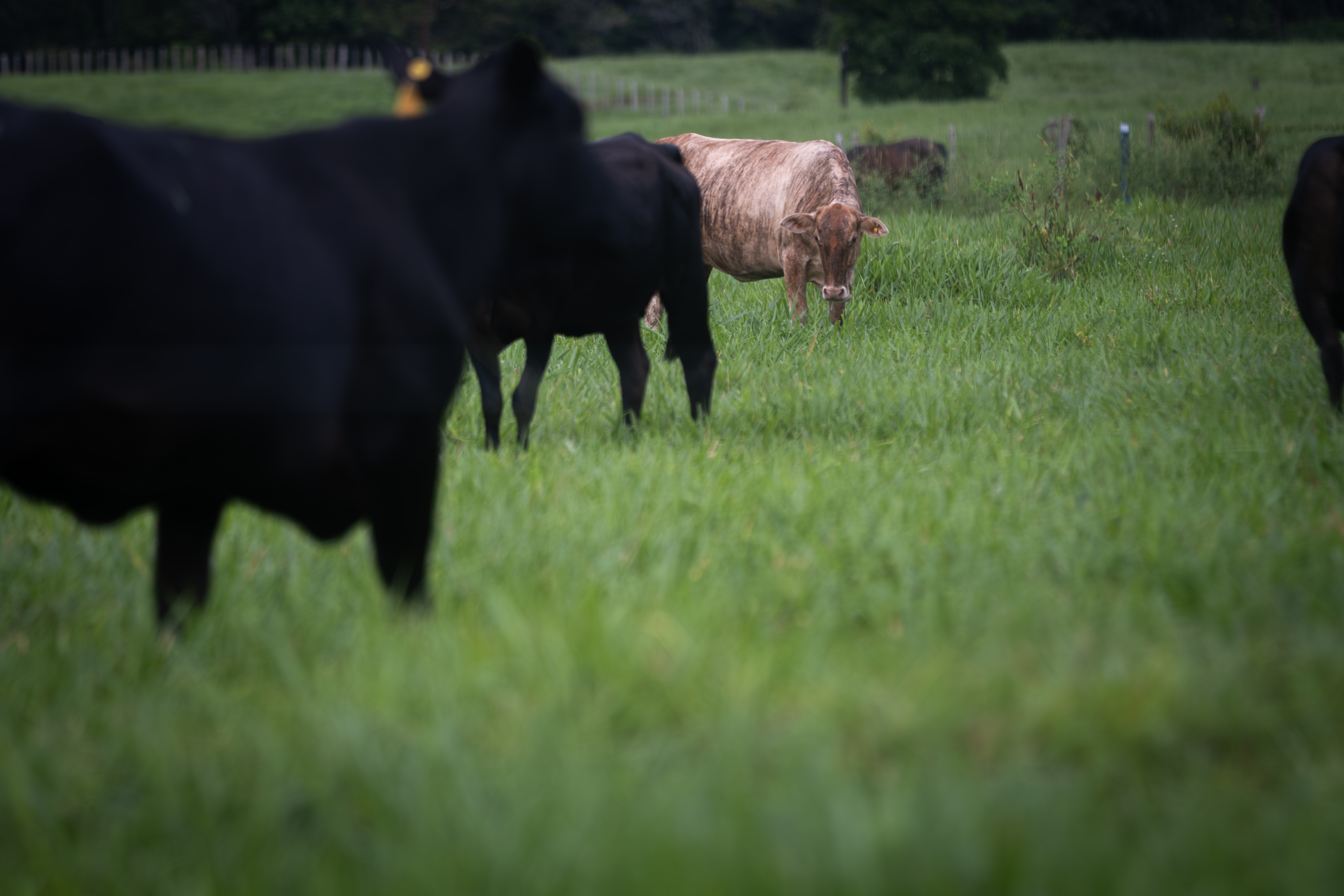
Junior invested in soil correction and the selection of pasture species suitable for the region’s climate, such as Zuri grass. The farm’s structure includes a feeding area and shaded areas for the cattle, as well as reproductive vaccines, vaccinations against infectious diseases, and vitamin supplementation. With these practices, Luiz Junior’s farm productivity is notable, with an average rate of 4.12 heads per hectare, well above the national average of 0.97, according to the latest Agricultural Census released by the federal data institute IBGE. Today, his net profit per hectare is close to R$ 3,500 (USD 625) per year, resulting in about R$ 200,000 (USD 37,700) annually with 57 hectares of recovered land.
Pedro Arthur Printes, a 45-year-old rancher and mechanic, joined the group after watching a TV program in which Luiz Junior’s father talked about the project. Out of 40 hectares of pasture, 12 are in the process of recovery. In 2021, he began soil analysis and applied inputs such as lime, phosphorus, potassium, nitrogen, and micronutrients to correct its acidity.
Acidic soil has lower fertility, which hampers root growth and plant access to nutrients, resulting in less pasture for the animals, explains Denis Tostes, agricultural consultant at ViaVerde Agroconsultoria. Another step was to use electric fences to divide Pedro Arthur’s land, explains the agricultural consultant. This allows for more appropriate grazing and respects plant physiology. Thus, root health and pasture longevity improve. Consequently, animal performance also increases, as well as carbon sequestration. Finally, it was necessary to rotate the cattle based on the grass height. “For example, if I use 40 centimeters of grass in a paddock [a fenced area for the animals], when it reaches 20 centimeters, I remove the cattle. With this size, within 15 to 20 days, I can get back to 40 centimeters,” details the rural producer, “that’s why I rotate them according to the height of the grass.”
No shortage of challenges
Both producers face logistical and financial challenges. Road transportation in the region is poor, with wooden bridges that cannot support heavy loads, and freight cost to Oriximiná is high. Since the Ukraine war, the prices of soil correction items have increased significantly, as many inputs come from Russia. Road transport in the region, a low-scale mode that would be the solution to the problem, remains inadequate.
The rural producer cites that bridges, which should be made of concrete to support loads, are handmade and wooden, which cannot bear 50 tons of a truck or trailer. “Our roads cannot accommodate trucks; I have a lot of difficulty bringing inputs to the farm precisely due to transportation issues,” says Pedro. “I am doing what I can in sustainable agriculture, but I have to go in my car, buy, leave it in town, store it, and bring it in small amounts because no trucks come here.”
Additionally, both producers are awaiting land regularization to obtain the land ownership title. Luiz Junior has 299 hectares of open land, 52 hectares of legal reserve, and 17 hectares of preservation area. Pedro Arthur has 87 hectares of land, of which 40 are open and 33 are legal reserves, with no permanent preservation area.
The most efficient cattle ranching in Oriximiná is based on good agricultural practices that balance animal husbandry with environmental preservation. Roberto Giolo, a researcher at Embrapa Gado de Corte, the federal research institute, explains that good management ensures higher productivity and resilience in extreme climate events. Soil analysis, nutrient correction, and the use of electric fences are common practices. Pasture rotation is another important technique, allowing plants to recover adequately before being grazed again.
The producers also invest in training their staff to apply animal welfare practices, ensuring that animals receive good quality food and water and have adequate shaded areas. Controlling vermin and following the vaccination schedule are essential for animal health. On the social side, worker welfare is also a priority, as satisfied workers treat animals better, resulting in better performance and higher revenue.
The most generic explanation for the more efficient cattle ranching practiced by the Oriximiná group is that it is based on good agricultural practices. Giolo, from Embrapa, explains that the better the management, the more likely the productivity will reflect positively. “This ensures that the producer can even endure more drastic events that may occur, such as droughts or extreme weather events.”
Soil analyses and electric fences
It all starts with the land. Together with a technician, it is necessary to conduct a soil analysis to determine which nutrients are lacking and which grass will provide proper management for the region. In Oriximiná, Pedro received assistance from consultant Tostes to help restore 12 hectares of land out of a total of 40. In 2021, he began soil analyses and applied inputs such as lime, phosphorus, potassium, nitrogen, and micronutrients to correct its acidity. Acidic soil has lower fertility, which hampers root growth and plant access to nutrients, resulting in less pasture for the animals.
Another step was to use electric fences to divide Pedro Arthur’s land, explains the agricultural consultant. This allows for more appropriate grazing and respects plant physiology. Thus, root health and pasture longevity improve. Consequently, animal performance also increases, as well as carbon sequestration. Using barbed wire is an old technique and is not recommended, as it can injure the animals. Smooth wire is less efficient because, although it effectively delimits the space, cattle can jump over it, requiring it to be rebuilt. Electric fencing makes animals “smarter” without hurting them like barbed wire. Additionally, it is the most cost-effective way to fence animals.
The next step was to focus on pasture rotation. There are various ways to do rotation. The number of divisions varies according to the resting period of the forage [plant used as food for the animals], so it can recover and reach a height suitable for grazing. Pedro mainly has the Brachiaria species on his property, which needs approximately 30 days of rest.
The most common method is to divide the area into four parts. “The producer rotates the animals according to the pasture availability of a certain paddock [a fenced grazing area],” says Giolo. Each forage plant has its growth period, and pasture stocking also helps vary the time the cattle will spend in it. In the most suitable management, the plant should be allowed to reach half its height before changing the animals. All this is done based on the rancher’s judgment.
The rural producers consulted for the report have invested in staff training, such as training their foremen and cowhands to implement animal welfare practices. “It is common to forget about animal welfare, which is precisely managed by the cowhand and foreman,” explains Giolo. “It is very common to treat animals poorly, which results in weight loss and poorer meat quality for slaughter.” Animal welfare involves creating conditions where the animal can express all its natural needs. Starting with the basics, the demand for food must be met, such as providing good quality feed and water. Ideally, they should not drink from rivers to avoid soil erosion due to trampling.
Treatment must address the cattle’s behavior needs. “They like to graze in groups, for example,” explains Giolo. It is also essential to have appropriate areas for cows and bulls, with shade if possible. “This provides thermal comfort to the animal, addressing its natural needs.” Welfare also includes animal health. To prevent ectoparasites and endoparasites, treatment should follow the vaccination schedule for the region. Additionally, vermin control with antibiotics and other medications is necessary. For calves, the umbilical cord should be treated to prevent rot and any potential diseases. The weaning period is also observed. A calf stays with its mother until eight months of age before being separated, with a possible variation of two months for earlier and later weaning.
One of the first to join a sustainable livestock project in the region, Luiz Souza, 82 years old, a rancher since 1968, and father of Luiz Junior, adds that there is a lack of comprehensive technical knowledge, in addition to the absence of a good soil laboratory with recommendations for pastures.
Souza speaks about the lack of an export slaughterhouse in the region, as there is no full utilisation of slaughtered animals. Joining the project, funded by Mineração Rio do Norte and consisting of technical advice to local ranchers, was also difficult at first in 2015. “People were already disillusioned with governmental initiatives, although the project was not,” explains Souza. In a meeting with local ranchers, 14 agreed to follow the consultancy. Today, there are approximately 80 rural producers engaged in the project. A sign of success for the endeavor.
Top image: Luiz Junior, a cattle farmer in the Amazon region. Credit: Amanda Lemos/O Mundo Que Queremos
For more information about the work done by O Mundo Que Queremos, go to the links below:
O Mundo Que Queremos institute

 aidoni.org