
By Richard Sultan, from Juba
 For various reasons, many South Sudanese have the experience of living in a foreign country, and I am no exception, having lived in Kenya for more than half a decade. But the hospitality accorded to me and other millions aside, no Kenyan has for once referred to my nationality as South Sudanese, instead opting to call me “Msudi”, a Kiswahili lingua-franca for Sudanese. For many around the globe, South Sudan still does not exist.
No wonder, the world is still coming to terms with what South Sudan achieved en route to and at the just concluded Paris 2024 Olympics because of such sentiments. The USA men’s basketball team will forever remember the night in London, on the 20th July, when they narrowly escaped a moment of a biblical David-Goliath story, beating South Sudan in London by just a single point.
In a typical African style, the clique which some would describe as envious – and whom I refer to as haters -made attempts to call it a one-off. Then came the D-day: the first game by South Sudan’s men’s basketball team at the 2024 Paris Games. The Olympic organisers pretended ignorance of our presence by playing the wrong national anthem, something our boys responded to on the basketball court, defeating Puerto Rico by 90 to 79, ohh! Hate us or love us, the whole world started consulting Google about us.
After the curtains closed on the Paris 2024 Olympics, a lazy friend of mine, and a real hater from neighbouring Kenya called me to tell me, “I saw you making a lot of noise online, how come your team exited early from Paris 2024 without a medal?”
I thought of pumping some sense into his sluggish head but thought otherwise. I decided to copy and forward him this powerful message from my sister Adhieu Majok, which said “It wasn’t a post about the win, but the beauty of South Sudan, an incredibly diverse people, and culture that is often unknown to others because it isn’t ‘news’ to them.”
“More than 13 years ago, South Sudan was just a dream, including discussions on our status. Our Basketball Team has put us on the map for something incredibly positive, an indication of what investment and good leadership can do.”
It’s South Sudan, not Sudan
Adhieu Majok’s response also answers a Ugandan friend who asked me how a country currently in a bloody conflict between two generals – confusing our nation with our big northern neighbour, Sudan – has managed to put together a basketball team so good to scare those from the developed world.
Any obscene word would do for an answer to such a question, but on second thought you will pity his geography teacher or the syllabus that prioritizes the Study of British Columbia so far away in North America.
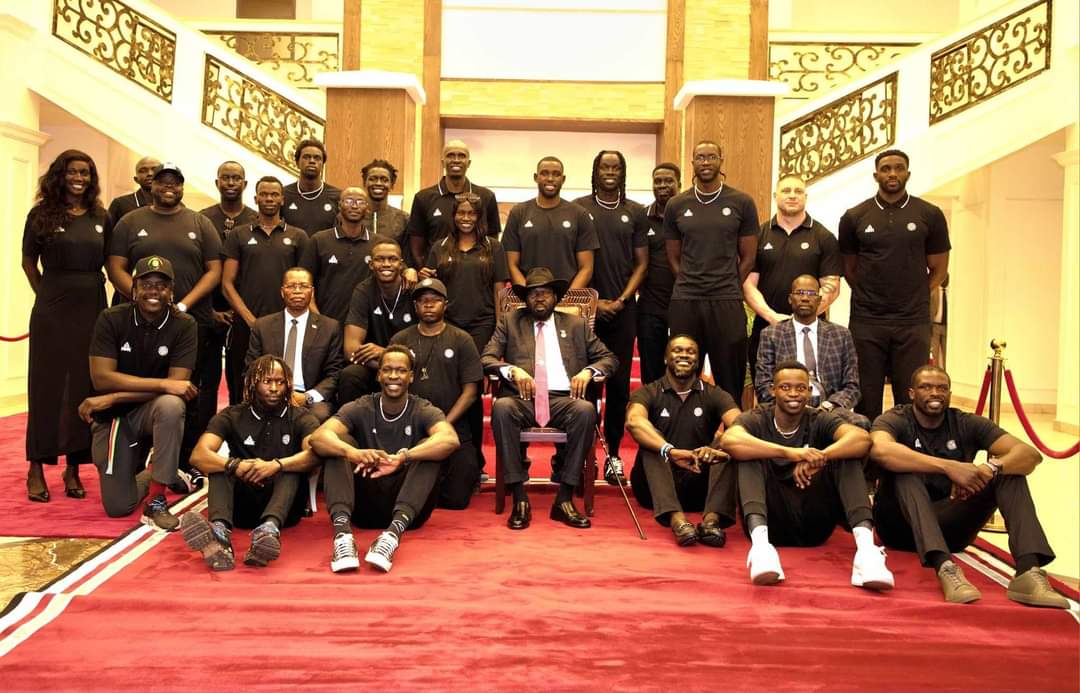
Back home, in a grand ceremony reminiscent of national pride and togetherness, the team arrived to a hero’s welcome, securing an audience with President Kiir.
A statement from the President’s office says in a show of solidarity and determination to advance the sporting industry, the government has allocated land for the construction of an ‘Olympics city’.
The President was also quick to point out that while the team did not get medals, their spirit and teamwork brought attention to the nation and its burgeoning sports culture.
As we watched the Presidential audience with the team on the government-owned South Sudan Broadcasting Corporation (SSBC), a discussion ensued on what’s next for the team and basketball in the country. With the team currently relying on the goodwill of its association’s President Luol Deng, a retired NBA star, nobody wants to imagine its fate if Deng’s coffer runs low. Talent-wise, the country has in abundance as witnessed in the Jr NBA league, thanks again to a partnership between the National Basketball Association (NBA) Africa, Stanbic Bank, and the Luol Deng Foundation to reach 450 boys and girls.
In the midst of our discussion, someone interrupted by asking, “What about Luol Deng as a Presidential Candidate in the forthcoming December elections?” The suggestion drew mixed reactions and loud laughter before the discussion resumed.
Despite the little investment in sports in the country, most South Sudanese agree that the national team are now an inspiration to a generation of basketball players in South Sudan – men and women. As Akol Dok, of Orus Consulting, said: “If this talent is cultivated, with the right infrastructures, it will cement South Sudan’s position as a powerhouse and a source of livelihood for young boys and girls,”
(Edited by Rogerio Simoes)
Read also: Conflict in Sudan pushing South Sudan’s economy down the cliff

 aidoni.org