
With oil production significantly affected by the war in Sudan, high inflation plagues the young nation, with residents starting to take to the streets to protest – a reminder of how dependent South Sudan still is on political and economic stability in its larger neighbour.
By Richard Sultan, from Juba (edited by Rogerio Simoes)
Dr. John Garang De Mabior, considered the founding father of South Sudan, was convinced of the country’s potential to be the breadbasket of Africa. Developing agricultural economy was the key component of his vision for South Sudan, which involved “taking towns to the villages rather than people to towns”.
The strategy was to use the oil money to fuel agriculture, growing crops to sell in international markets to generate revenue to build quality schools and hospitals. Today, however, 90% of South Sudan’s economy still relies on oil, pumped through Sudan’s Red Sea port – the same Sudan from which it became independent in 2011.
This means the current civil war in Sudan has been a disaster for its young southern neighbour, which suffers from a crippling economy, with high inflation affecting the whole population.
Neutrality and losses
Aware of the importance of a stable and peaceful Sudan, South Sudan maintained a publicly neutral stand on the conflict, despite being named by a UN panel of experts for transporting fuel through its territory to the Rapid Support Forces (RSF). When the fighting between the RSF and Sudan Armed Forces (SAF) erupted in April 2023, South Sudan ended up receiving the highest number of refugees – over 700,000 – compared to other neighboring countries, according to UN statistics.
South Sudan’s petroleum officials remained worried since the onset of the conflict, as 98% of the government operating budget relies on the 150,000 barrels of oil which is transported, refined, and exported through Sudan’s facilities. In February 202,4 S&P Global Insights published oil exports out of Sudan’s Bashayer port terminal had hit an 11-month low level, of 79,000 barrels per day, in January, a situation that affected the government coffers, weakening the governments ability to pay its bills and increasding prices of goods, pinching the ordinary South Sudanese daily.
By early 2024, insecurity in neighbouring Sudan and the flooding of the oil wells has made it challenging for South Sudan to pump much-needed crude oil to reach export markets, Central Bank Governor Dr James Alic Garang said in a press conference. He added that further delay in oil reaching international markets were being caused by Houthi attacks against ships in the Red Sea.
However, real signs of the Sudan Conflict pulling its 13-year-old Southern neighbor down the cliff came on 10th February, when the Sudan government issued a “force majeure” on oil exports from South Sudan, due to a pipeline rupture outside the de-facto government’s control.
The incident began on 10 February, but at the time it was largely hidden from the public, according to a report by S&P Global Commodity Insights. If not repaired, the rupture threatens a key source of revenue for the governments of both countries, particularly for South Sudan, which has failed to develop alternative revenue sources since its independence from Sudan in 2011.
“Suffering and starving”
“At this rate, I am going to have to walk in the mornings despite the distance and the heat,” said Simon Drici, a construction foreman. His reaction comes after a litre of petrol rose to SSP 3,500 from SSP 1,350 in most petrol stations, a change public transport operators passed to the passengers.
Price increases have been part of the South Sudanese reality, in the capital, Juba, and other states in the country, since the curb in oil production and restricted trade to northern neighbour Sudan led to a spike in prices.
Prices of basic goods and public services such as transport increased unexpectedly in the start of the year, residents say, as the South Sudanese Pound (SSP) has lost value vis-à-vis the US dollar, falling from 1,260 SSP for USD 1 to 3,000 SSP or higher in the parallel black market. Passengers appeared bewildered as they discovered they must pay an additional SSP 500 to make the 2-kilometer trip from Gudele to Juba Town on 14-seater minibusses. This number reveals the gravity of the national tragedy: according to the UN’s World Food Programme, 7.1 million South Sudanese are “acutely hungry”, from a total population of 11 million.
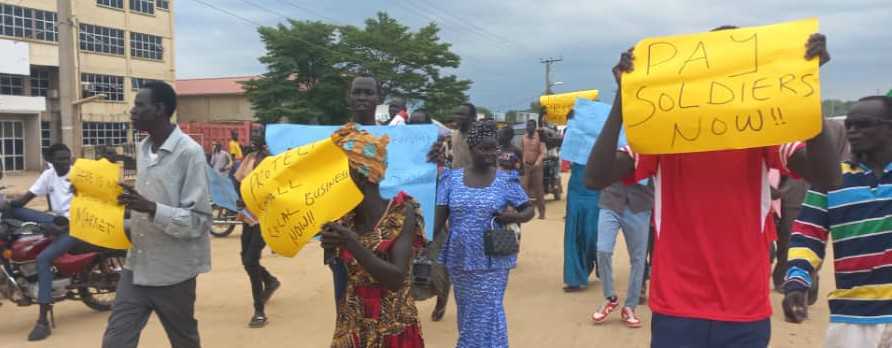
On the 24th of June, dozens of Bor town residents took to the streets over the rising cost of living and economic challenges caused by the war in neighboring Sudan. The protests, fueled also by delays in the payment of civil servants’ salaries, saw demonstrators brandishing placards expressing their anger.
“We are suffering and starving. We can no longer afford food, medication, or school fees,” reads part of the petition submitted to the United Nations Mission in South Sudan Field Office in Bor and directed to the newly-appointed Governor Mahjoub Biel Turuk. The petition, addressed to President Salva Kiir, calls for immediate action to alleviate the pain of rising prices. “We have suffered enough and this time, we want our voices heard!”, chanted the protesters.
As the news of the demonstration trickles in the capital Juba, the silent soothing anthem of “If only Dr Garang” was alive became louder. Simon Drici happened to be at a construction site, looking bored and out of place. “Why don’t you go nurse your hangover home?”, asked another man. “I have been sober for a week,” Drici replied, facing the wall instead of his friend, who cuts a bending gym-like pose behind him, the effect of the heavy bricks on his shoulders.
He reminisced to his friends the good old days when his current single-day pay of about USD 3 would feed his family of four for a week, unlike now, when it can last for only two days if used with good economic skills.
Despite the rights and freedom to a peaceful association stated by the country’s transitional National Constitution, in its article 24, so far protests had largely been in support of the government’s activities. The authorities have repeatedly said that they haven’t procured rubber bullets or tear gas since the birth of the country 13 years ago – a sentence meaning there are only live bullets waiting for anyone trying to protest against the government.
A protest in Bor is also symbolic, as it was where the first bullet of what later became 21years of South Sudan’s independence struggle was shot. Also, it is the birth and ancestral home of the visionary late founding father of South Sudan – Dr. John Garang.
On 25 June, lectures from the University of Upper Nile lecturers took their “if only Garang was alive” anthem to the streets of Juba. No one should believe the academics will be the last group to risk live bullets to have their voices heard. Civil servants in Western Bahr Gazal State have voiced their concerns to the media, demanding the payment of their wages. While the war continues in its larger neighbour, the discontent in South Sudan keeps growing.
Top image: people protest in the streets of Bor, South Sudan. Credit: Radio Tamazuj
More about South Sudan:

 aidoni.org
One thought on “Conflict in Sudan pushing South Sudan’s economy down the cliff”